At Moon Above, we have always believed that the quality of an advisory relationship is not measured by access to beautiful objects alone. It is measured by the rigour with which each opportunity is analysed, tracked, and executed.
Most art advisors work from spreadsheets, email threads, and memory. We decided to build something different.
A Private Inventory System Built for Precision
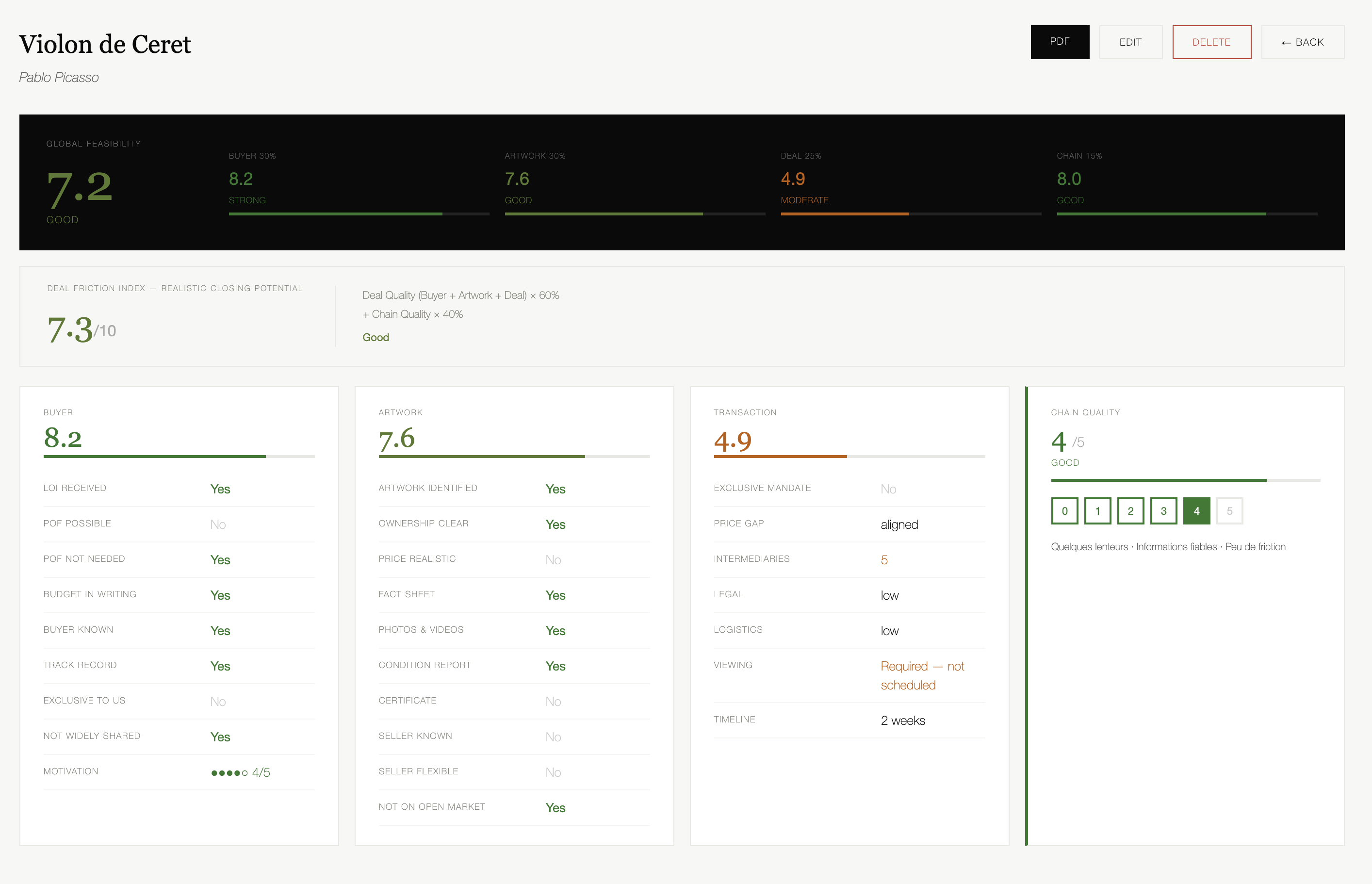
Every artwork we work with — whether in an active mandate or under preliminary analysis — lives in our proprietary dashboard. Each record contains the full documentation chain: factsheet, condition report, provenance, exhibition history, photographs, certificate of authenticity, ownership status, and pricing analysis. Nothing is left to inference.
When a counterparty asks a question, we answer from a structured record — not from recollection.
The Inquiry Scoring Algorithm
The core of our system is a real-time feasibility score that evaluates every active inquiry across four dimensions.
Buyer Seriousness
Has a Letter of Intent been received? Is proof of funds available — or unnecessary for this transaction? Has the buyer confirmed their budget in writing? Do we know them? Do they have a track record of completed acquisitions? Is the request exclusive to us, or circulating across the market? What is their genuine level of motivation — assessed honestly, not optimistically?
Each criterion generates a weighted score. The result is not an opinion. It is a structured assessment.
Artwork Quality
Has the work been formally identified? Is ownership clear and documented? Is the asking price consistent with comparable sales? Is a factsheet prepared? Are photographs and video available? Does a condition report exist? Is a certificate of authenticity in hand? How is the work positioned on the open market — held discreetly, or already widely seen?
A work that scores poorly on documentation is not a bad work. It is a work that is not yet ready to transact.
Deal Structure
Do we hold an exclusive mandate? How significant is the gap between buyer budget and seller expectation? How many intermediaries stand between us and the two principals? What is the legal complexity — a straightforward private sale, or a succession, trust, or disputed estate? What are the logistics? Has a viewing been scheduled, or is it still theoretical? What is the realistic timeline?
Each variable is scored. The deal structure dimension alone often tells us whether closing is probable — or merely imaginable.
Chain Quality
This is the dimension that most advisors never measure. It is also, in our experience, the one that most often determines the outcome.
A chain rated 5 out of 5 means fast responses, coherent information, direct access to decision-makers, no shifting narratives, no friction. A chain rated 2 out of 5 means constant follow-ups, incomplete information, invisible principals. A chain rated 0 means proven inconsistencies, ghosting, or contradictions significant enough to warrant immediate exit from the opportunity.
Several of the most promising opportunities we have encountered did not fail because of the artwork. They failed because of the chain. A Lichtenstein and a Chagall — both exceptional works, both serious opportunities — both lost to counterparty dysfunction before the transaction could be structured.
The lesson is not anecdotal. It is structural. Chain Quality is now weighted at 15% of our Global Feasibility Score, alongside Buyer Seriousness (30%), Artwork Quality (30%), and Deal Structure (25%).
The Deal Friction Index
The Global Feasibility Score tells us how strong an opportunity is on paper. The Deal Friction Index tells us whether it is actually executable.
It is calculated as a weighted combination of Deal Quality — the average of the first three dimensions — at 60%, and Chain Quality at 40%. The result is a single number: the Realistic Closing Potential.
A mandate scoring 9.0 on paper but carried by a chain at 1.5 will produce a Realistic Closing Potential well below what the opportunity deserves. That number forces a conversation: do we invest further in this mandate, or do we redirect our attention to something that can actually close?
That question — asked early, with data behind it — is worth considerably more than months of optimistic follow-up.
The Contacts Network
Every person connected to a mandate is mapped. Dealers, brokers, intermediaries, lawyers, buyers, sellers, co-advisors. The system tracks who introduced whom, who has worked with whom, and — critically — who has been flagged as a problematic counterparty in previous engagements.
When a new contact appears in a chain, we cross-reference them against the network before proceeding. The art market is considerably smaller than it appears. Patterns repeat. Reputations travel, even when they travel slowly.
Why We Built This
We built this system because the art market operates on opacity — and opacity, ultimately, is the enemy of good advice.
Every dealer has an inventory. Every advisor has contacts. Very few have a system that connects the two: that scores each opportunity with the same rigour regardless of how compelling it feels in the room, that flags deteriorating chains before they consume time and credibility, that produces a documented assessment of every active mandate and forces intellectual honesty at every stage.
Our clients never see the dashboard. What they experience is the output: faster and more accurate assessments, better-qualified introductions, and mandates that either close or are exited with clarity — never allowed to quietly expire because no one wanted to be the first to say it was over.
Every serious project begins with qualification. This is the infrastructure that makes qualification possible.